Image Credit -Deviantart.net/
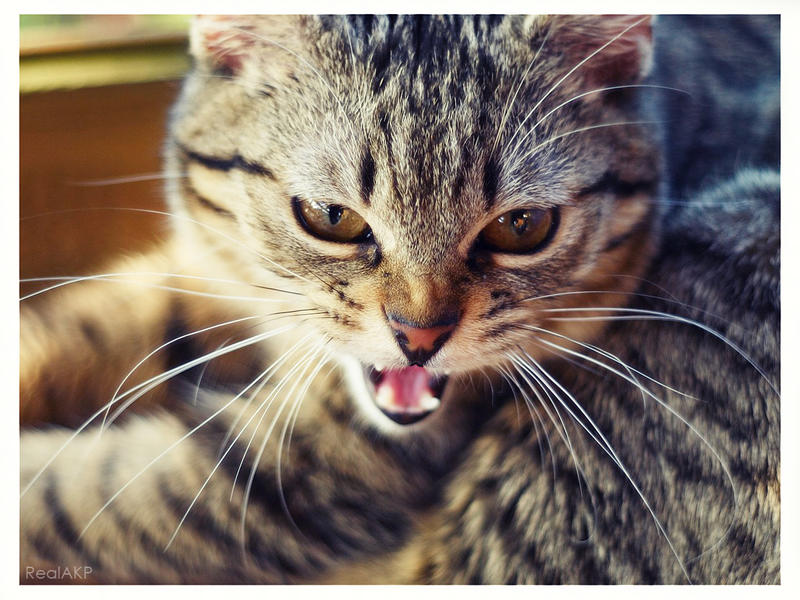
Aggression is one of the most common behavioral problems in cats. A cat has five lethal potential weapons – four clawed paws and his teeth, compared to a dog's weapon of his mouth. Cat bites can inflict severe lacerations, which can get infected quite easily. It can also lead to cat scratch fever, an infectious disease which can cause flu-like symptoms. Let us look at some of the most common postures associated with feline aggression:
Offensive postures
- An upright, straight-legged, stiff stance
- Stiff rear legs, with a sloped back and a raised rear end
- Stiff tail that is held straight or lowered
- Direct stare
- Upright ears with the back rotated forward
- Piloerection, including the fur on the tail
- Constricted pupils
- Howling, growling or yowling
Defensive postures
- Head tucked in
- Crouching
- Wide open eyes with fully or partially dilated pupils
- Tail curved and tucked in around the cat's body
- Ears that are flattened backward or sideways on the head
- Piloerection
- Anxious cats might retract their whiskers. Fearful cats pan out their whiskers and extend it forward to asses the distance between themselves and the danger
- Open mouthed spitting or hissing
Classifying the different types of aggressive behavior
- Between cats – Yo will often find unneutered male cats being aggressive towards each other. They do this to challenge each other for territory and access to potential mates. Aggression between two household cats in more complex and subtle than conflict between two outdoor tomcats. It might be related to physical size, lack of socializing with other cats or to a learned association of the opponent with something unpleasant.
- Defensive or fearful – Fear aggression is a common effect of threat perception, especially if the cat is in a position from which he cannot escape. The more threatening the animal, person or object his, the more heightened his aggression will be. The most common body postures associated with defensive or fearful aggression include defensive signals, like flattening the ear, crouching, leaning away, tucking the tail, pupil dilation or rolling to the side, and aggressive signals like spitting and hissing, growling, piloerection, biting, swatting and scratching.
The other kinds of aggressive behavior are seen because of territorial fights, rough play, redirected anger (when your cat cannot take out his anger on the opponent), excessive petting (constant petting can lead to the generation of static electricity in the cat's fur), pain, maternal and predatory instincts.If your cat is excessively aggressive, he might need a medical workup. A lot of cats exhibit aggressive behavior because of some medical complication. Apart from acutely painful conditions, cats with a thyroid abnormality, orthopedic problems, cognitive dysfunction, adrenal dysfunction, sensory deficits and neurological disorders can show increased aggression and irritability. Geriatric cats tend to suffer from insecurity and confusion, which can lead to aggressive behavior. Certain medications can also alter the mood of your cat and affect his susceptibility to aggression.
Aggression Between Cats at Home: Causes and Solutions
Inter-cat aggression is not unheard of. There could be many reasons why your cats are being aggressive toward each other. Being the independent and adaptable animals that they are, cats do not find the need to get along with other cats at home. They may try and avoid each other if they do not get along. Cats get into outright fights only when they are cornered or they know that the other cat won't retaliate. If your cats have been engaging in physical conflicts and hostile acts, don't just let it sit. Cats do not just resolve their fights if you let them be, chances are their physical brawls will only get worse if you do not intervene.
What's causing aggression between your cats?
The first step to resolving the aggression between your cats is to find out what is causing it in the first place. If your cats have been living harmoniously previously, and have resorted to physical fights out of nowhere, then you want to trace back to see since when their behavior has changed. Is your cat reacting this way ever since the other cat returned from the vet visit? It could be its response due to territorial aggression. Or has there been any changes in and around the house? Your cat could be redirecting its aggression toward the other cat as a result. They may just be fighting over the shared food bowl or scratch post, for all you know. Cats resort to bullying too, especially so if the other cat in question shows apprehension or similar responses when the cat takes a threatening or aggressive stance. Sometimes, cats act aggressive due to conditions like arthritis. Either way, you want to figure out what is leading to this aggressive behavior in your cats.
Resolving aggression
Separate the cats using a blanket or a water gun. You can even use a loud rattling noise or clap to startle them and break the fight. If they are resorting to fights as they have to share the same resources, then cut down the competition by giving them both separate bowls, litter boxes and such. Pheromones can help reduce cat aggression (use it with a diffuser). Isolate them in separate rooms for a few days, and have brief supervised sessions where they are in each other's company. If they do not show any signs of aggression you can increase the time that they spend around each other, else go back to separating them. Don't try and calm your cat when it's being aggressive, it is best left alone until it calms down. Have a vet look at your cat to see if a medical condition or injury may be leading to aggressive behavior.